



Bicep Tendon Surgery Recovery Time: What to Expect After Surgery
The primary bicep tendon surgery recovery time varies depending on the type of procedure, the location of the tear (proximal or distal), and individual healing factors. Most patients seek clarity about the recovery time from bicep tendon surgery so they can plan rehabilitation and return to daily activities with realistic expectations.
At Manhattan Orthopedic Care, we guide patients through every stage of recovery with personalized care and evidence-based rehabilitation strategies.
Understanding Recovery Time
Recovery after biceps tendon repair requires patience and structured rehabilitation. The biceps tendon surgery recovery time is typically broken into phases:
- Early healing and protection
- Gradual restoration of motion
- Strengthening and functional recovery
- Return to full activity
Because tendon healing occurs gradually, the bicep surgery recovery time may extend several months before full strength returns.

Factors That Influence Recovery Time From Bicep Tendon Surgery
The recovery time from bicep tendon surgery depends on multiple variables:
- Location and Severity of the Tear
Partial tears typically heal faster than complete ruptures, requiring complex tendon reattachment. - Surgical Technique Used
Minimally invasive procedures often allow quicker recovery compared to open reconstructive approaches. - Patient Age and Overall Health
Younger, healthier patients generally experience more efficient tissue healing and rehabilitation progression. - Commitment to Rehabilitation
Consistent participation in prescribed therapy significantly improves strength restoration and mobility outcomes. - Adherence to Activity Restrictions
Avoiding early strain on the tendon prevents setbacks and supports proper biological healing.
Every patient heals differently. Understanding these factors helps set realistic expectations and supports successful recovery.
Typical Timeline for Bicep Tendon Surgery Recovery Time
While individual experiences vary, most patients follow a structured timeline:
Weeks 0–2: Immediate Post-Op Phase
- Wear the sling for 4 weeks, and as directed by your surgeon, to protect the surgical repair.
Do: Keep the sling on when walking or sleeping unless instructed otherwise.
Don’t: Remove it to test your arm strength or lift objects. - Swelling is common and managed with ice and prescribed medications.
Do: Apply ice packs 15–20 minutes at a time several times daily.
Don’t: Apply heat or skip medications without medical guidance. - Movement is restricted to protect the healing tendon.
Do: Perform only approved wrist and hand exercises.
Don’t: Reach overhead, lift groceries, or push yourself up from a chair with the surgical arm.
Weeks 2–6: Early Mobility Phase
- Gentle range-of-motion exercises help prevent stiffness without straining the repair.
Do: Perform guided pendulum or assisted shoulder exercises as prescribed.
Don’t: Force range of motion or stretch into pain. - The sling may be used less frequently as healing progresses.
Do: Remove it at home after 4 weeks, if cleared by your surgeon.
Don’t: Discontinue use entirely unless medically approved. - Supervised physical therapy.
Do: Attend all therapy sessions consistently.
Don’t: Attempt advanced exercises found online.
Weeks 6–12: Strengthening Phase
- Light resistance is introduced carefully.
Do: Use light resistance bands under therapist supervision.
Don’t: Lift heavy weights or resume gym workouts prematurely. - Rebuilding coordinated shoulder mechanics becomes a focus.
Do: Practice controlled reaching and light household tasks.
Don’t: Perform repetitive overhead lifting. - Comfort during routine activities increases gradually.
Do: Return to light desk work if approved.
Don’t: Engage in physically demanding labor.
3–6 Months: Functional Recovery
- Many patients resume regular daily routines.
Do: Gradually increase activity levels with guidance.
Don’t: Immediately resume competitive sports without clearance. - Continued strength gains
Strength continues to improve with consistent training.
Do: Maintain home exercise programs.
Don’t: Stop strengthening once pain subsides. - Gradual resumption of higher-demand tasks
More strenuous activities may be reintroduced.
Do: Return to recreational activities progressively.
Don’t: Attempt maximal lifting or sudden high-intensity movements without approval.
The overall biceps tendon surgery recovery time can extend beyond six months for athletes or individuals seeking full strength restoration.
Managing Expectations During Recovery
The recovery time from bicep tendon surgery is not uniform. Some patients regain functional independence quickly, while others require longer rehabilitation to optimize strength. Key principles:
- Follow Medical Guidance
Adhering strictly to post-operative instructions reduces complications and promotes optimal tendon healing. - Attend Physical Therapy
Structured therapy restores range of motion, strength, and functional shoulder mechanics safely. - Avoid Premature Overexertion
Returning to lifting or sports too early may compromise tendon repair integrity. - Monitor Healing Progress
Regular follow-up appointments ensure recovery milestones are met and concerns are addressed promptly.
Patience and consistency support better long-term outcomes.
Why Professional Care Matters
Tendon healing is biologically complex and requires structured, physician-directed oversight to protect the repair, restore biomechanics, and prevent re-injury. Without appropriate monitoring, patients risk stiffness, incomplete healing, persistent weakness, or premature return to activity that can compromise surgical outcomes. Understanding the bicep tendon surgery recovery time in a clinical context allows patients to progress safely through each healing phase.
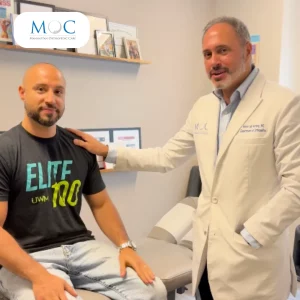
At Manhattan Orthopedic Care, patients are treated by experienced orthopedic surgeons, Dr. Armin Tehrany and Dr. Koroma. Their training in orthopedic surgery and sports-related tendon pathology ensures accurate diagnosis, appropriate surgical technique selection, and carefully structured post-operative protocols to improve quality of life.
Professional oversight includes individualized rehabilitation timelines based on tendon integrity, fixation method, tissue quality, and patient-specific healing capacity.
Book a Bicep Surgery Consultation
If you are exploring treatment options or recovering from surgery, expert guidance can make a difference.